Solar
How much can you save with solar panels in 2026?
Solar panels can cut your electricity bill significantly, but how much depends on factors that many guides miss. Here we walk through what actually drives the savings and what you can realistically expect.
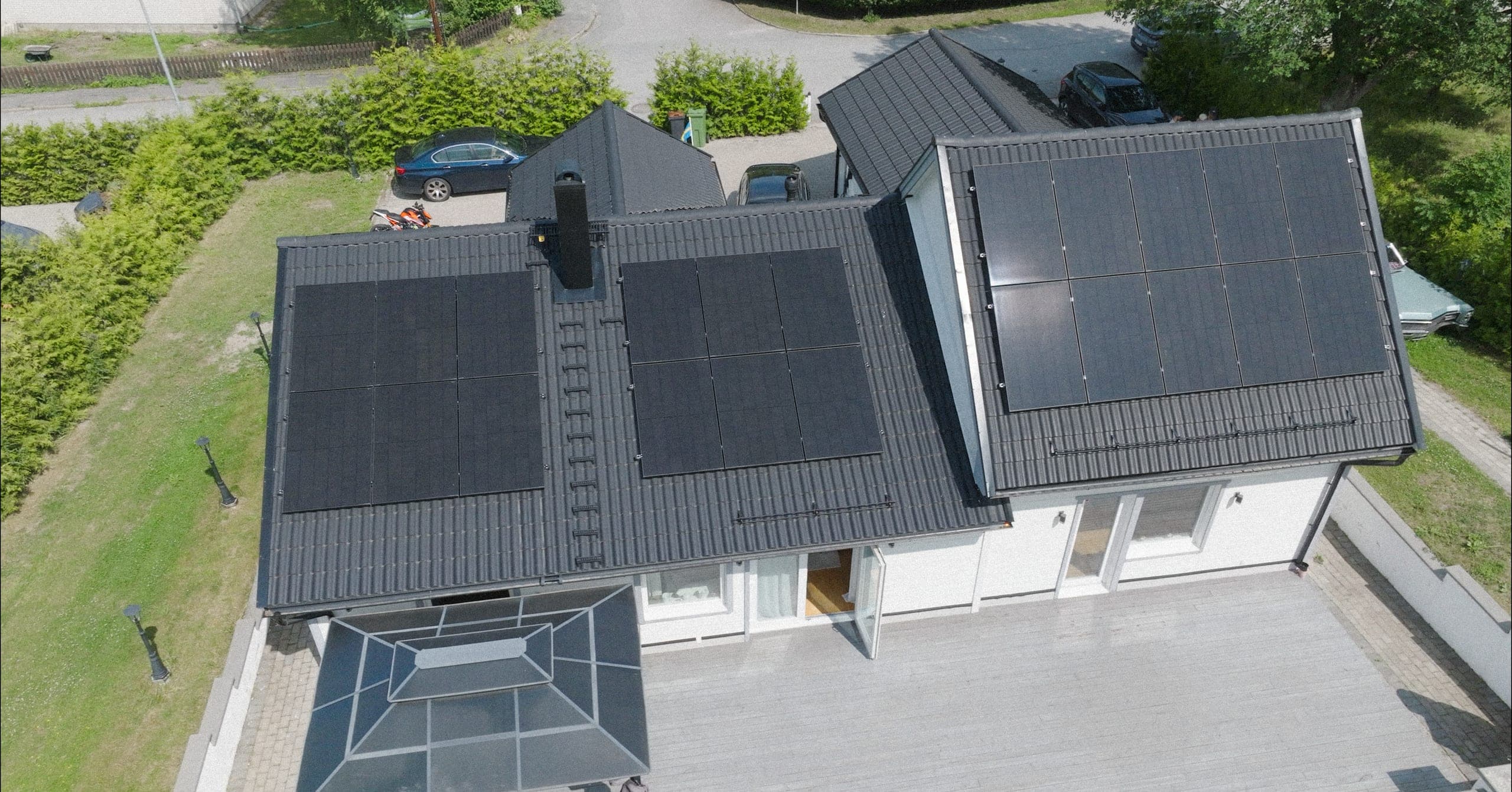
The question of how much you save with solar panels is easy to ask but hard to answer honestly. Online you will find everything from optimistic calculations where the system pays for itself in five years to more cautious estimates. Both can be true — it depends on which house you are talking about.
There is no universal answer. But there are factors that almost always determine the outcome, and they are important to understand before you make a decision.
20–40%
self-consumption without a battery
50–80%
self-consumption with a battery
8–14 tkr
possible annual saving for an average-sized house
What determines how much you save with solar panels?
The most important factor is not the number of panels but what share of the electricity you produce you use yourself. Electricity you produce and use at home is worth more than electricity you sell back to the grid. You avoid taxes and fees on purchased electricity, while surplus that is sold earns a lower payment.
This is called self-consumption and is one of the key figures in the whole calculation. A household that uses a lot of electricity during the day — for example when working from home, charging an electric car or running a heat pump — gets higher self-consumption and therefore a better return on the investment.
The seasonal difference most people underestimate
Solar production is at its highest during the summer half of the year, while a home's electricity demand is often greatest in winter. Especially in homes with a heat pump or electric heating. This means that in summer solar panels often produce more than the house consumes, while during cold winter months they cover a smaller part of the need.
Over a full year, solar panels can still account for a significant share of the household's total electricity use. But in December and January production is low across large parts of Sweden, and in practice you remain dependent on purchased electricity. That is why the annual saving can look good on paper while the winter electricity bill is still high.
A battery can even out the difference between day and night, but it cannot store the summer's surplus for winter. That is why it is important to calculate over the full year and not just over the sunniest months.
The three factors that affect the saving most
How large your actual saving turns out to be depends above all on three things.
Total electricity consumption. The more electricity you use, the more kilowatt-hours the solar panels can replace. A house with electric heating, an electric car and a large living area has better conditions than a small house with low consumption.
When the electricity is used. Solar panels produce electricity during the day. If consumption is low in the middle of the day, more electricity is sold to the grid and the saving shrinks. This is where a battery makes a difference — it stores the day's production and makes it available when the house needs it in the evening.
The roof's orientation and pitch. A south-facing roof with a 30–45 degree pitch gives the highest total production. East and west give slightly lower annual production but a more even flow across the day, which in some cases can benefit self-consumption.
What is a realistic saving in 2026?
For an average house with an annual consumption of 15,000–20,000 kilowatt-hours and a system of 8–12 kilowatts, annual production can land at 7,000–11,000 kilowatt-hours, depending on where in the country the house is located. According to the Swedish Energy Agency, the same system in southern Sweden produces roughly 15–20 percent more than in the northern part of the country.
Without a battery, self-consumption is often 20–40 percent of production. With a battery, in many households it can rise to 50–80 percent. That makes a big difference to the actual saving.
With an electricity price including taxes and fees of 1.50–2.00 kronor per kilowatt-hour, a well-integrated system with solar panels and a battery can reduce the cost of purchased electricity by roughly 8,000–14,000 kronor per year for an average-sized house. That is a range, not a promise. The outcome depends on the electricity price, usage patterns and how the system is integrated.
Why are solar panels alone rarely enough?
Solar panels produce the most in the middle of the day. Without a battery the surplus is sold to the grid and electricity is bought back in the evening, often at a higher price. A battery stores the day's production and makes it available when the house needs it.
Ahead of 2026, more grid operators have introduced capacity tariffs. This means you pay more if you use a lot of electricity over short periods. A smart battery can even out these peaks and lower the grid fee, on top of the saving on purchased electricity.
It is important to remember that there are always some losses when electricity is stored and converted in a battery. A small part of the energy is lost in the process, which affects the actual saving. In practice these losses are often outweighed by the value of reducing demand peaks and avoiding buying electricity at expensive times.
If the battery is also connected to a network that takes part in support services — where Svenska kraftnät pays to stabilise the frequency of the grid — it can generate additional income that improves the economics. At the same time, the total saving is always directly affected by the electricity price. At lower electricity prices the saving decreases, even if the system produces just as much electricity.
The heat pump is the factor many people miss
If you have a heat pump, it is probably the house's largest consumer of electricity. That also makes it the component with the greatest potential to lower the electricity cost if it is integrated in the right way with solar panels and a battery.
A heat pump with intelligent control can adapt its operation to when the solar panels produce the most. It can heat water in the middle of the day with self-produced electricity, reduce the load in the evening and work together with the battery to avoid expensive demand peaks. Installing solar panels without integrating them with the rest of the energy system is the difference between producing electricity and actually using it to the full.
For many homeowners, it is not a lack of sun that limits the saving, but that solar panels, battery and heat pump are installed as separate products by different suppliers. Each part works on its own, but the whole is rarely optimised.
Elvy installs all three as an integrated solution and takes responsibility for making them work together. The system is controlled by software that takes into account the electricity price, the weather forecast and the house's actual consumption pattern. You make no investment of your own. Instead you pay a fixed monthly cost for the duration of the contract. That includes equipment, installation and a full operating guarantee. If something breaks during the contract, it is Elvy's responsibility to fix it at no extra cost.
Keep readingMore to explore
- Solar
Your house as a power plant: how the prosumer works in the Swedish grid
The electricity grid is changing fundamentally. And in that change, your house plays a role few foresaw ten years ago. Not as a consumer of electricity, but as a producer, a storage unit and an active participant in the energy market.
- Solar
Do I own my solar panels? What applies with purchase, leasing and an energy subscription
Who owns the solar panels on your roof depends entirely on the contract you have. Here we untangle the differences between buying, leasing and an energy subscription — and what it means in practice.
- Heat pump
What does a new heat pump cost per month?
A new heat pump rarely costs what you think it does – and often more than you budgeted for. Here we break down the real monthly cost, whatever way you choose to finance the switch.
0+
Homeowners no longer manage their own power and heat. They decided they had better things to do.
Curious to do the same?